

A wafer ball valve—also known as a thin-profile or compact ball valve—is an industrial valve that regulates the flow of media in a pipeline or enables rapid opening and closing by rotating a spherical closure element 90 degrees around the valve body’s central axis. Featuring a compact design without integrated flanges, it is secured between two pipeline flanges using double-ended studs (bolts).
Compared to standard ball valves, this design reduces the overall length by 40%–60% and the weight by approximately 30%, making it particularly well-suited for applications with limited installation space or narrow piping configurations.
Operating Principle
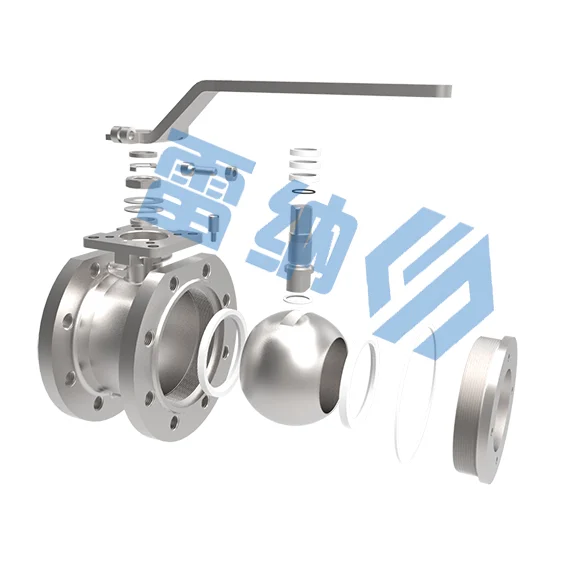
The operating principle of a wafer ball valve is relatively straightforward: it controls fluid flow by rotating the valve core (the sphere). The process is as follows:
- Opening the valve: Rotating the handle or actuator turns the valve core (sphere) 90 degrees, aligning the valve’s internal passage with the pipeline, thereby allowing fluid to pass through freely.
- Closing the valve: Rotating the handle or actuator in the opposite direction turns the valve core (sphere) another 90 degrees, positioning the valve’s internal passage perpendicular to the pipeline. This blocks the flow of fluid, effectively shutting off the line.
Wafer Ball Valves vs. Standard Ball Valves
While wafer ball valves and standard ball valves share the same fundamental operating principle, they differ in terms of how they handle installation loads and their auxiliary sealing mechanisms.
Installation and Load Bearing
In a wafer ball valve (and similar valve types), the opening/closing mechanism is positioned across the diameter of the pipeline. Within the cylindrical passage of the valve body, a disc-like closure element rotates between 0° and 90°; at 90°, the valve is fully open. Such valves are typically installed in a horizontal orientation.
In contrast, a standard flanged ball valve features integrated flanges at both ends of the valve body. It connects directly to pipeline flanges via bolts, with the valve body itself bearing the full load of the connection, which provides greater structural rigidity.
Sealing Auxiliary Mechanism
Wafer ball valves feature valve seats equipped with built-in spring preloading. In the event of overpressure within the valve cavity, the downstream seat can automatically retract to relieve pressure, subsequently resetting itself. The sealing force varies in proportion to the clamping force applied by the bolts.
In contrast, standard ball valves typically utilize a floating seat design, where the fluid pressure pushes the ball against the seat to create a seal. These valves lack an automatic pressure-relief function, and the sealing force increases as the fluid pressure rises.
Advantages and Disadvantages of wafer ball valves
Advantages
Space and Weight: The axial length is 40%–60% shorter than that of standard flanged ball valves, significantly saving installation space. The overall weight is only 30%–50% of an equivalent flanged ball valve.
Installation and Maintenance: These valves do not require integrated flanges; instead, they are clamped between two existing pipeline flanges using stud bolts, increasing installation efficiency by over 50%. During maintenance or disassembly, there is no need to remove the long flanges on either side—simply loosening the bolts allows for the quick removal of the valve, drastically reducing downtime.
Flow Performance and Sealing: The full-bore design ensures fluid resistance nearly identical to that of a straight pipe section of the same length, resulting in minimal pressure loss and a reduction in pumping energy consumption by approximately 23%. The ball surface undergoes high-precision polishing, which, combined with the resilient sealing structure, enables bidirectional zero-leakage performance (meeting API 598 Class A standards).
Cost Control: Manufacturing costs are 20%–30% lower than those of equivalent flanged ball valves, with total lifecycle operating costs reduced by approximately 40%.
Disadvantages
Pressure and Size Limitations: Due to constraints imposed by the preloading force of the stud bolts, the nominal pressure for mainstream products is generally limited to the PN16–PN40 range; they are entirely unsuitable for ultra-high-pressure applications.
High Requirements for Installation and Maintenance: These valves demand exceptional parallelism and coaxiality from the pipeline flanges. Any deviation exceeding 0.5 mm can introduce additional stress, leading to leaks.
Limited reliability in specialized operating conditions: These valves are not well-suited for applications involving frequent adjustment or media containing solid particles or fibers. Impurities can easily become embedded in the sealing surfaces, scratching the ball and causing permanent seal failure.
When to Use
Wafer ball valves support various actuation methods—including manual, pneumatic, and electric—and can handle a wide range of fluids, such as water, steam, oil, and corrosive media. Thanks to their compact, lightweight design and ease of installation, they are ideal for piping systems where space is limited. They are widely used in sectors including municipal water treatment, chemical processing, pharmaceuticals, and food production—particularly in applications that require frequent maintenance and inspection.
Summary
Combining a space-saving design with a highly competitive initial cost, wafer ball valves offer an ideal solution for engineering challenges in modular skid-mounted equipment and retrofit projects with restricted space. If you are looking for the right wafer ball valve for your project, Leina is an excellent choice—please feel free to contact us.