

A wafer-style ball valve controls fluid flow by rotating a valve core (the ball). It is commonly used for applications such as fluid shut-off, distribution, and flow direction changes. It features a “wafer” design, meaning the valve is clamped between two pipe sections using bolts, eliminating the need for the extra space required by traditional flange connections. Thanks to its unique structural design and excellent performance, it is widely used in various piping systems.
The working principle of a wafer-style ball valve is relatively simple: fluid flow is controlled primarily by rotating the valve core (the ball). To open the valve, the handle or actuator is turned to rotate the ball 90 degrees, aligning the valve’s internal passage with the pipeline’s bore and allowing fluid to pass freely.
Conversely, to close the valve, the handle or actuator is turned in the opposite direction to rotate the ball another 90 degrees. This positions the valve’s passage perpendicular to the pipeline’s bore, blocking the flow and achieving shut-off.
Structural Features
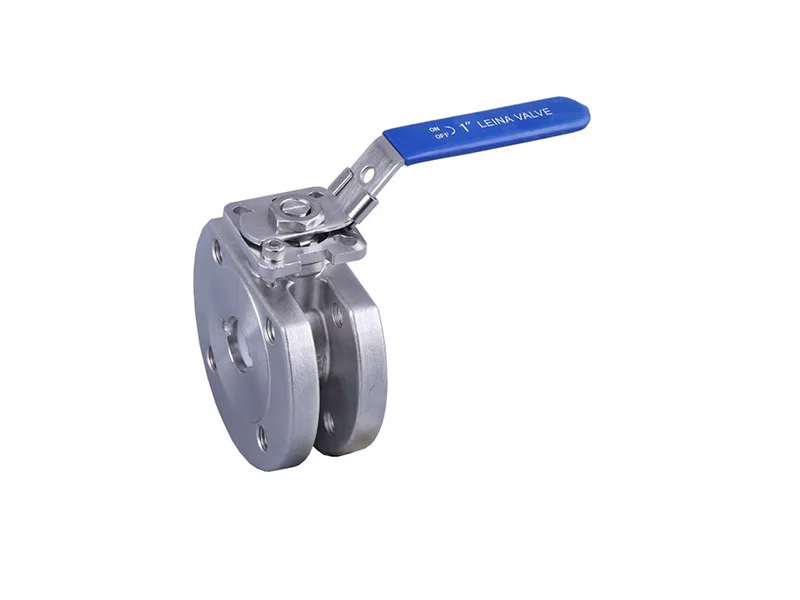
- Compact Structure: The wafer-style design results in a compact structure that occupies minimal space during installation, making it ideal for piping systems with limited room.
- Lightweight: By eliminating flanges and their associated bolt connections, the valve is relatively lightweight, which helps reduce the load on the piping system.
- Easy Installation and Maintenance: Installation and removal are straightforward; the valve is simply clamped between pipe sections and secured with bolts. This design greatly simplifies the installation and maintenance processes.
- Excellent Sealing Performance: These valves typically utilize soft or hard sealing structures, ensuring superior sealing performance and effectively preventing fluid leakage.
What are the differences between wafer-style ball valves and standard ball valves?
| Feature | Wafer-Style Ball Valve | Standard Ball Valve |
| Structural Design | Uses a wafer (sandwich) body design | Typically uses flanged or threaded connections |
| Installation Method | Simply clamped between pipes and secured with bolts | Flanged types require alignment with pipe flanges and bolting; threaded types are screwed into pipe threads |
| Maintenance & Repair | Easily removed from the pipeline for inspection/maintenance by loosening bolts | Flanged types require removing bolts and flanges; threaded types require specific skills and tools for disassembly |
| Applications | Suitable for space-constrained piping systems; widely used in municipal water treatment, chemicals, pharmaceuticals, and food industries | Suitable for various industrial piping systems, especially for high-pressure, high-temperature, and high-flow control scenarios |
| Cost Differences | Lower material and processing costs due to the elimination of flanges and extra connecting hardware | Higher manufacturing costs due to increased material and processing requirements; higher installation and maintenance costs |
As shown in the table above, the primary advantage of the wafer-style ball valve is its compact structure and minimal space requirement, resulting in lower purchase and maintenance costs. In contrast, while standard ball valves entail higher manufacturing, installation, and maintenance costs, their superior sealing performance and structural strength meet the rigorous demands of industrial operating conditions.
All LEINA valves are designed and manufactured in strict accordance with advanced domestic and international standards such as GB, ANSI, API, DIN, BS, and JIS. Materials include stainless steel, carbon steel, and alloy steel. Our products cover a wide range of specifications, with sizes up to 20 inches (DN500), pressure ratings up to 2500LB (PN420), and an operating temperature range of -120°C to 450°C. We welcome your inquiries and orders.